

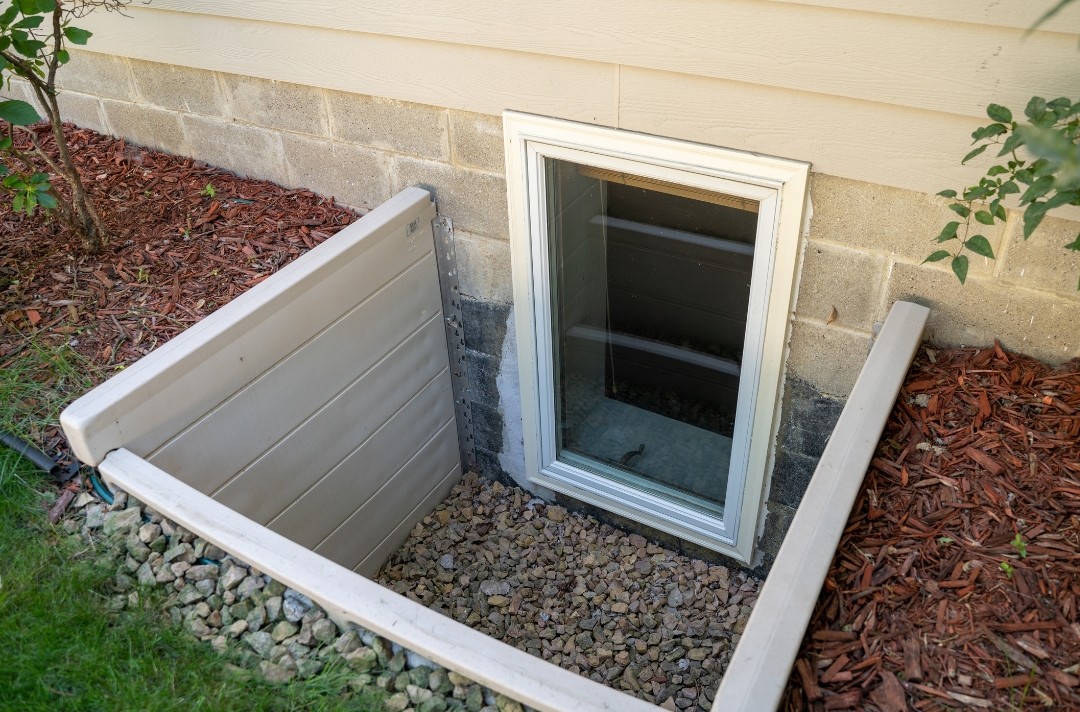
A basement egress window is a window sized and placed so people can get out of your basement in an emergency. You’ll hear the term “egress” used to describe windows that act as a legal escape route from a sleeping space or living area in the basement. These aren’t decorative or ventilation-only windows. They’re safety features required by building codes when a basement is finished or used as a bedroom or living space. They come up a lot when sellers or buyers talk about usable basement living space.
You might have seen smaller basement windows that let in light — those usually don’t qualify as egress. If you want a space counted as a bedroom for permits or resale, you need a window that meets the egress criteria set by the National Building Code (NBC) as adopted locally.
What Basement Egress Windows Are
An egress window gives people in a basement a way out if a fire or other emergency blocks the main exit. It must:
- open easily from the inside without keys, tools or special knowledge
- have a clear opening big enough for a person to climb through
- be part of an exit path that leads directly outside the house.
The window sill (bottom of the opening) can’t be so high that a person can’t reach it easily. If the opening is below ground level, it usually sits inside a window well.
Code-Compliance Basics
Building codes don’t leave this up to interpretation. If you’re finishing a basement or creating a bedroom, you must follow the code adopted in your municipality (often the NBC with local amendments). If you skip this, you can have problems at inspection, when selling the home, or with your insurance later.
The National Building Code sets a baseline that is widely adopted:
- Minimum clear opening area: 0.35 m² of unobstructed space (clear of sash, stops, hardware)
- Minimum dimensions: at least 380 mm high and 380 mm wide in the clear opening
- Operation: opens from inside without special tools
- Sill height: generally no more than 1.5 m above the finished floor
- Window wells: if the window is below grade, there must be space in front of it (commonly about 760 mm clear) for someone to climb out and for rescue access.
It’s worth noting that merely having a window that looks big doesn’t mean it meets code. Many products are labelled “egress”, but inspectors measure the clear opening — the part you can actually get through.
Dimensions and Jurisdiction Rules
The NBC criteria above are a national model. Your local authority may add rules or details based on the regional environment, snow loads, or local practice. For example:
- municipalities often adopt the NBC in whole or with changes
- permit officials will check window well size and drainage
- if you locate an egress window under a deck or porch, you still need room to open it and exit.
As one example from local building practice, the City of Mount Pearl refers to the NBC’s 0.35 m² and 380 mm minimums in its subsidiary apartment guidelines and specifies about 760 mm clearance in front of the window well.
Why Egress Windows Matter
People often focus on egress windows only when finishing a basement. But they matter beyond just meeting code:
- they provide a secondary escape route if stairs or a door are blocked
- they let in natural light, making the space more comfortable and marketable
- a space without proper egress usually can’t be legally listed as a bedroom.
If a basement bedroom doesn’t have an egress window that meets the code you can’t usually get a building permit for that bedroom. That can affect your resale value and your insurance coverage.
For specific numbers and latest local amendments, always check with your local building department before you start work. There are good general rules, but the final authority is your jurisdiction’s building official.
