

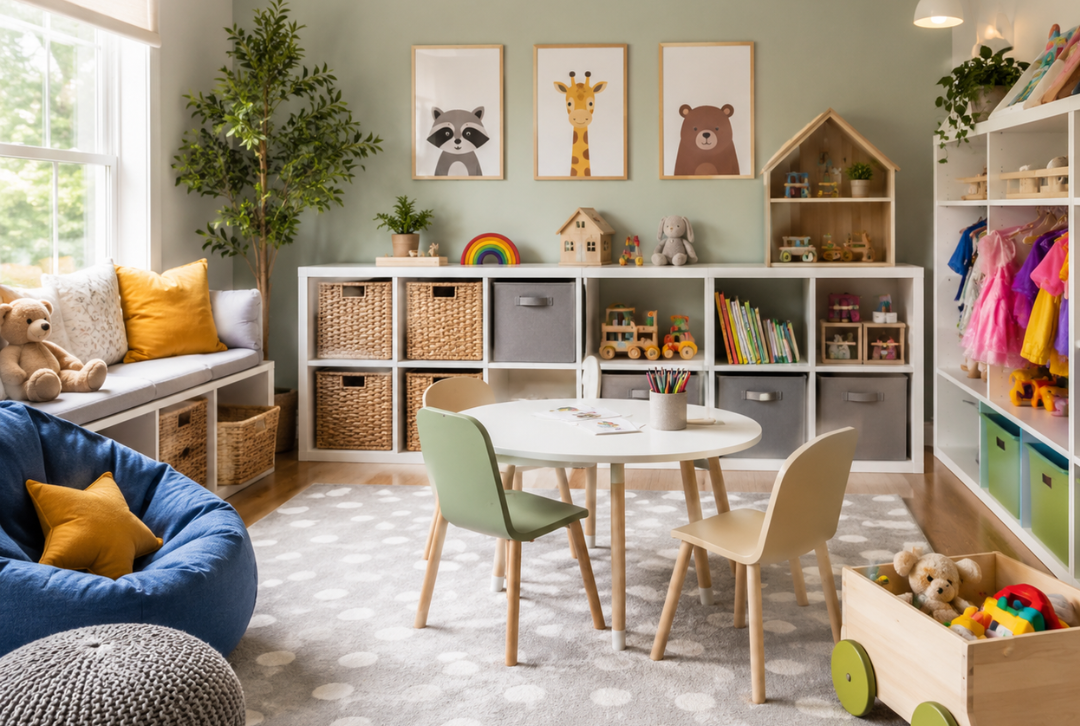
Children don’t need much encouragement to make a mess. Give them a few toys and a little imagination, and before long the playroom is full of books, craft supplies, games, and pieces that seem to have wandered into every corner of the room.
The good news is that a playroom doesn’t have to be perfect to work well. A few smart design choices can make the space easier for your children to enjoy and much easier for you to keep under control.
Start by thinking about how your child actually plays
Before buying more storage bins or furniture, spend a few days paying attention to how the room is used.
Do they build elaborate LEGO creations that stay up for days? Love arts and crafts? Prefer reading in a quiet corner? Maybe they spend more time pretending the room is a pirate ship than playing with the toys you expected.
Design the room around those habits instead of trying to copy what you see online. A playroom that fits your family’s routine will stay useful much longer.
Keep toys where kids can reach them
Storage works best when children can use it themselves.
Open shelves, low cubbies, and baskets allow younger children to find what they want without asking for help. Even more importantly, they can put things away on their own.
Clear containers are especially helpful because kids can see what’s inside without dumping everything onto the floor. If you use solid bins, simple picture labels work well for children who aren’t reading yet.
Create simple zones
A playroom doesn’t need walls to have separate spaces.
Breaking the room into small activity areas helps reduce clutter and gives everything a natural home.
For example:
- Building toys in one area
- Arts and crafts near a table
- Books and puzzles together
- Dress-up clothes in one corner
- A soft space for reading or quiet time
Children often move more easily from one activity to another when the room has some structure.
Rotate toys instead of storing everything
One of the easiest ways to reduce clutter is to simply put some toys away.
Choose a selection of toys to keep out and store the rest in a closet or basement. Every month or two, swap them.
Children often become excited about toys they’ve forgotten, making them feel new again without spending money on replacements.
It also keeps the room from becoming overwhelming.
Choose furniture that grows with your family
Kids grow quickly, so avoid furniture that’s only useful for one stage.
Look for pieces that can adapt over time, such as:
- Adjustable tables and chairs
- Bookcases with removable bins
- Storage benches
- Cube shelving
- Toy chests with soft-close lids for safety
As children get older, many of these pieces can transition into bedrooms, homework spaces, or hobby rooms.
Leave some open floor space
Not every inch of the room needs to be filled.
Children often need open space to spread out train tracks, build forts, play board games, or simply move around.
Resist the urge to fill every empty wall with shelves or every corner with storage. Sometimes less furniture makes the room work better.
Make cleanup part of playtime
The easier cleanup is, the more likely it will happen. Instead of asking children to organize dozens of individual toys, give them a few simple categories.
One basket for stuffed animals.
One bin for building blocks.
One shelf for books.
One container for art supplies.
A five-minute cleanup feels much more manageable than trying to organize hundreds of individual items.
Don’t forget about the grown-ups
Most playrooms aren’t used only by children.
Parents often read stories, help with homework, build towers, or watch from nearby while younger children play. A comfortable chair, a small side table, or even a built-in bench makes the room more enjoyable for everyone. If you enjoy spending time there, you’re more likely to use the space.
Think about resale, too
If you’re planning to sell your home in the next few years, avoid making the room too specialized. Bright paint colors, permanent climbing walls, or built-in features designed for very young children may not appeal to every buyer. Neutral walls, flexible storage, and furniture that can easily be removed help buyers picture the room as a playroom, home office, bedroom, or hobby space.
That flexibility can make your home attractive to a wider range of buyers.
A playroom doesn’t have to be picture-perfect
Social media is full of beautiful playrooms that look untouched. Real family homes rarely stay that way for long.
A successful playroom isn’t the one with the most expensive shelves or the trendiest décor. It’s the one your children enjoy using and that’s simple enough to tidy up at the end of the day.
Focus on practical storage, flexible furniture, and spaces that suit the way your family lives. You’ll spend less time organizing and more time enjoying the moments that matter.